1. What Is the Metaverse?
The metaverse is a vast, immersive, three-dimensional digital universe where people interact with each other and digital environments using avatars. It blends the physical world and virtual space into a shared, persistent experience.
In simple terms:
- It’s often described as the next evolution of the internet
- Instead of browsing websites, you enter and experience digital worlds
- Users can work, socialize, shop, learn, and play in real time
Unlike today’s internet (2D screens), the metaverse creates a sense of presence—you feel like you’re actually “inside” the digital world.
2. Origin and History
Early Concept
The term “metaverse” was first introduced in 1992 by author Neal Stephenson in his novel Snow Crash.
In the book:
- People used avatars to interact in a virtual world
- The idea resembled a virtual version of the internet
Evolution Timeline
- Early 2000s: Platforms like Second Life allowed virtual interaction
- 2010s: Growth of VR/AR technologies
- 2020s: Big tech companies (Meta, Microsoft, etc.) invest heavily
- Present: Still evolving, with mixed success and ongoing development
The metaverse has transitioned from science fiction → experimental platforms → emerging ecosystem.
3. Key Features of the Metaverse
The metaverse is defined by several core characteristics:
1. Immersive Experience
Users feel physically present using Virtual Reality (VR) and Augmented Reality (AR).
2. Persistence
The world continues to exist even when you log off.
3. Avatars & Identity
Users are represented by customizable digital avatars.
4. Interoperability (Future Goal)
Digital assets (like clothing or currency) could move across platforms.
5. Real-Time Interaction
People interact instantly with others globally.
These features make it fundamentally different from traditional digital platforms.
4. Technologies Powering the Metaverse
The metaverse is not a single technology—it’s a combination of many:
Virtual Reality (VR)
- Fully immersive digital environments
- Requires headsets (e.g., Oculus/Meta Quest)
Augmented Reality (AR)
- Adds digital elements to the real world
- Used in apps like Pokémon Go
Artificial Intelligence (AI)
- Powers avatars, NPCs, and personalization
Blockchain & NFTs
- Enables digital ownership (virtual land, assets)
High-Speed Internet (5G/Cloud)
- Supports real-time interaction at scale
Extended Reality (XR)
- Combines VR, AR, and Mixed Reality into one ecosystem
Together, these technologies create a fully interactive digital universe.
5. How the Metaverse Works
At its core, the metaverse is a network of interconnected virtual worlds.
Process:
- User enters via device (PC, VR headset, phone)
- Creates or uses an avatar
- Interacts in a 3D environment
- Communicates, trades, or explores
- Data and identity persist across experiences
It functions like a digital economy + social network + gaming platform combined.
6. Applications of the Metaverse
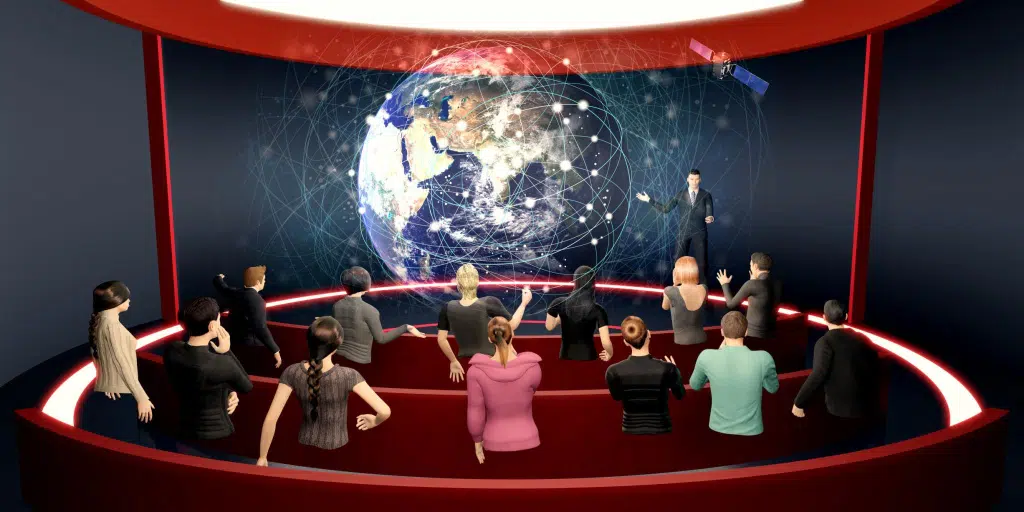
The metaverse has applications across many industries:
1. Gaming
- Most developed use case
- Games like Roblox and Fortnite already resemble metaverse environments
2. Work & Remote Collaboration
- Virtual offices and meetings
- Replace Zoom with immersive interaction
3. Education
- Virtual classrooms and simulations
- Medical and technical training
4. E-Commerce
- Try products virtually
- Buy digital goods and NFTs
5. Entertainment
- Virtual concerts, events, and social hangouts
6. Healthcare
- Therapy, rehabilitation, and simulations
The metaverse could transform almost every industry.
7. Economic Potential
The metaverse introduces a new digital economy:
- Virtual land and real estate
- Digital fashion and assets
- Creator economy (artists, developers)
- Cryptocurrency-based transactions
It allows people to:
- Earn money inside virtual worlds
- Build businesses without physical infrastructure
Some predictions estimated trillions in economic value—but results are still uncertain.
8. Challenges and Risks
Despite its promise, the metaverse faces serious issues:
Privacy Concerns
- Massive data collection (behavior, biometrics)
- Risk of surveillance
Security Risks
- Cyberattacks and identity theft
- Virtual fraud and scams
Mental & Physical Health
- Addiction and escapism
- Reduced real-world interaction
- Motion sickness (VR)
Ethical Issues
- Harassment and virtual crimes
- Lack of regulation
Technical Limitations
- Expensive hardware
- Limited infrastructure
- Scalability challenges
Experts warn that these issues must be solved before mass adoption.
9. Criticism and Reality Check
Recent developments show that: The Metaverse Was a $100 Billion Flop. It Should Make Us Think Twice About AI Predictions.
- Some metaverse projects have struggled to succeed
- Billions of dollars have been invested with limited adoption
- Critics argue it was overhyped
For example:
- Major platforms reported huge financial losses
- Some virtual worlds have very low active users
This suggests the metaverse is still in an early and experimental phase, not a fully realized future yet.
10. Future of the Metaverse
The future of the metaverse depends on several factors:
What Could Drive Growth:
- Better VR/AR hardware
- Faster internet (5G/6G)
- AI integration
- Open standards and interoperability
Possible Future Scenarios:
- Full adoption – becomes the next internet
- Partial success – used mainly in gaming and business
- Failure/hype cycle – replaced by other technologies (e.g., AI)
Most experts agree:
👉 The concept will evolve, even if current versions fail.
11. Conclusion
The metaverse represents a bold vision of the future—a digital universe where reality and virtual life merge.
Key Takeaways:
- It is an evolution of the internet into immersive 3D experiences
- Powered by VR, AR, AI, and blockchain
- Has applications in gaming, education, work, and commerce
- Faces serious technical, ethical, and social challenges
- Its future remains uncertain but highly influential
Final Thought
The metaverse is not just one platform or company—it’s a long-term transformation of how humans interact with technology. Whether it becomes the next big revolution or just another tech trend depends on innovation, adoption, and trust.



Thank you for this insightful guide on the Metaverse! I appreciate how you broke down its complexities, especially around emerging technologies. It would be fascinating to see a deeper exploration of user-generated content within these virtual spaces and how it could shape experiences. Do you think platforms like speed stars could play a role in enhancing community engagement?