In this in-depth but easy-to-understand article we’ll compare two of the most advanced language & multimodal AI models available today: Google’s Gemini 3, and OpenAI’s GPT-5.1. We’ll cover what each does, their strengths and weaknesses, use-cases, and how to pick between them.
What Are They?
Gemini 3
The model Gemini 3 is introduced by Google and its subsidiary research arm DeepMind. According to Google’s official blog:
- Gemini 3 is described as “our most intelligent model” combining multimodal reasoning (able to handle text, images, possibly video etc) and strong agentic/tool-use capabilities.
- It supports a very large context window (e.g., the blog mentions “1 million-token context window”) so it can process long inputs.
- It emphasizes three broad use-domains: Learn anything, Build anything, Plan anything.
- It also introduces “Deep Think” mode for even higher reasoning tasks.
GPT-5.1
The model GPT-5.1 comes from OpenAI. From the announcement page:
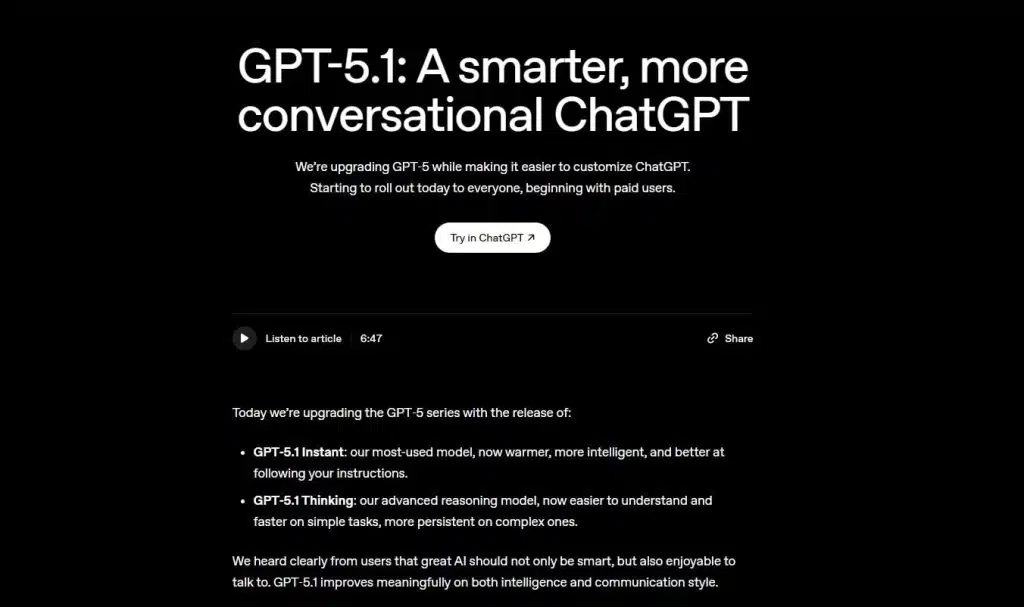
- ChatGPT-5.1 is described as an upgrade to the GPT-5 generation, with two model flavours: GPT-5.1 Instant and GPT-5.1 Thinking.
- GPT-5.1 Instant is the more conversational/warm-style model; GPT-5.1 Thinking is optimized for deeper reasoning, variable thinking time, more clarity.
- It also brings enhanced customization (tone/style control) so user experiences can be more tailored.
Core Features & Capabilities
Here’s a side-by-side look at some of the key features of each model (as per the official sources) to help compare.
| Feature | Gemini 3 | ChatGPT-5.1 |
|---|---|---|
| Multimodal capability (text + images + maybe video) | Yes: Gemini 3 claims strong multimodal reasoning, image/video capability. | While GPT-5.1 focuses primarily on improved reasoning & conversational style; multimodal details less emphasised in the announcement. |
| Reasoning / benchmark performance | Gemini 3 claims state-of-the-art on multiple AI benchmarks (e.g., “Humanity’s Last Exam”, GPQA Diamond) and strong long-context, tool-use, planning capabilities. | GPT-5.1 emphasises better instruction following, variable thinking time, stronger reasoning than previous GPT version. |
| Context window size / long inputs | Gemini 3 mentions “1 million-token context window”. | GPT-5.1 announcement doesn’t specify exact token window in the snippet; focus is more on reasoning & conversation. |
| User customization / style control | Doesn’t emphasise direct tone/style control in the same way; more on capability. | GPT-5.1 emphasises making ChatGPT “uniquely yours” with style presets (Friendly, Professional, Quirky, etc) and more direct control. |
| Tool-use / agentic capabilities | Gemini 3 emphasises “agentic development platform” (Google Antigravity) enabling autonomous agents, tool use, browser/terminal control. | GPT-5.1 focuses on better instruction-following and adaptable thinking time, rather than explicit “agentic” platform in the announcement. |
| Availability & rollout | Gemini 3: available in Google’s Gemini app, AI Mode in Search, developers (AI Studio), enterprise (Vertex AI). Deep Think mode coming later. | GPT-5.1: rolling out starting Nov 12 2025 for paid users, then free and logged-out users; API access planned. |
| Safety / responsible development | Gemini 3 emphasises safety: “most secure model yet”, testing against prompt-injection, misuse, independent evaluations. | GPT-5.1 mentions “system card addendum” for safety approach; emphasises smooth transition and sunset for legacy models. |
What’s New / What’s Improved
What Gemini 3 brings that’s new
- It claims to combine all the previous Gemini model strengths (native multimodality from Gemini 1, agentic capabilities & reasoning from Gemini 2) into one unified model.
- New Deep Think mode: For ultra-reasoning tasks, pushing beyond standard model.
- Very large context window and improved multimodal reasoning (e.g., ability to take in long videos, images + text + code) for “learn anything” or “build anything”.
- Strong tool/agent integration for developers: e.g., build in AI Studio, use in Google Antigravity (agentic dev platform) with the ability to plan, execute, code, etc.
What GPT-5.1 brings that’s new
- Warmed up conversational tone: GPT-5.1 Instant is described as “warmer by default and more conversational” than earlier.
- Better instruction-following: the model more reliably answers the question asked and follows instructions more accurately.
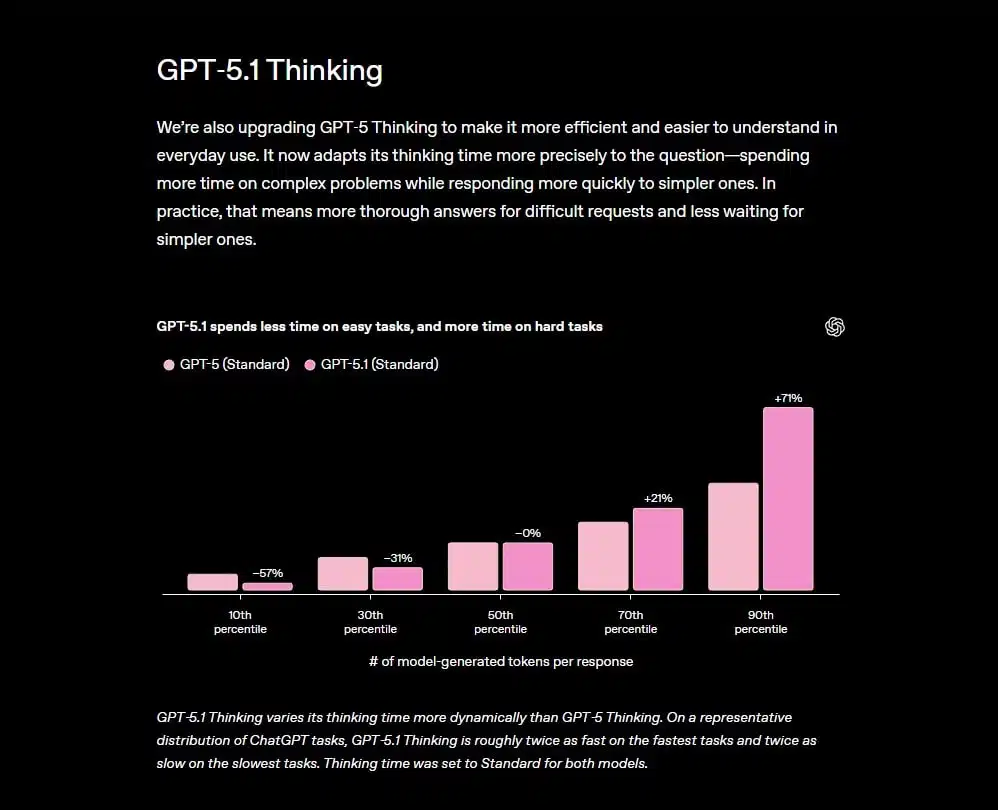
- Variable thinking time: GPT-5.1 Thinking adapts its reasoning time depending on task, faster for simple tasks, longer for complex tasks.
- More customization: The user can choose tone settings (e.g., Friendly, Professional, Quirky) and future granular controls (how concise, how warm, how many emojis) to tailor responses.
Strengths & Potential Limitations
Gemini 3 – Strengths
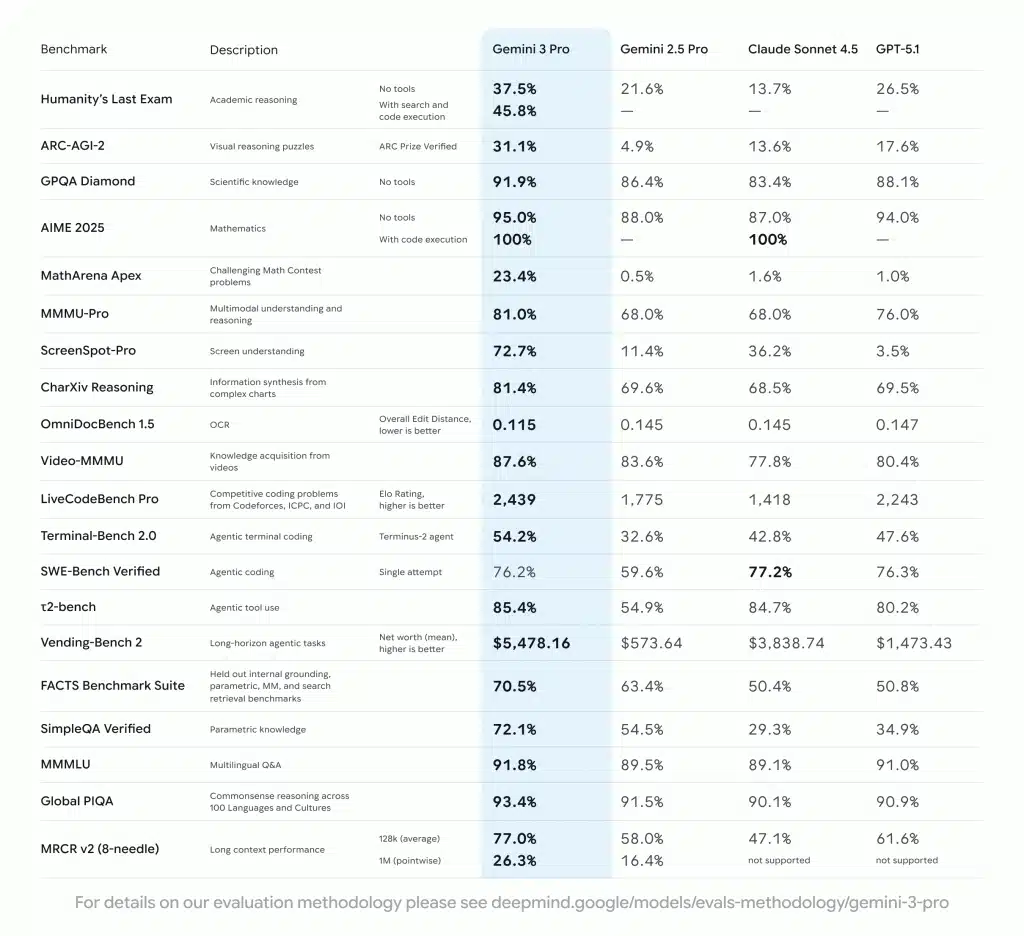
- Strong multimodal support: very helpful when you have inputs beyond plain text (images/videos/code) or want rich outputs (visualisation, UI generation).
- High reasoning and tool-use capacity: good for developers, researchers, or advanced workflows (building apps, automating complex tasks).
- Long context window: beneficial for large documents, long dialogues, multi-step workflows.
- Integration within Google ecosystem (Search AI Mode, Gemini app, Vertex AI) – may make it seamless for users already in that ecosystem.
Gemini 3 – Potential Limitations
- As with any new frontier model, availability may be limited (Deep Think mode coming later) and cost may be high for advanced features.
- Multimodal and tool-use features often require more complex prompts or platforms – for casual users plain text might be sufficient.
- While tuned for very advanced tasks, for very casual/conversational use one might not notice huge differences vs other models.
GPT-5.1 – Strengths
- Enhanced conversational tone and style: good for everyday users who want a natural “chat” feel.
- Reliable instruction-following: for tasks like generating content, summarisation, coding, etc, less need for highly crafted prompts.
- Customisation of tone/style is a plus for different user personas (professional, friendly, quirky).
- Strong rollout via ChatGPT and API – if you’re already using ChatGPT, upgrading to GPT-5.1 is likely smooth.
GPT-5.1 – Potential Limitations
- While reasoning is improved, the announcement doesn’t emphasise multimodal & agentic tool use as heavily as Gemini 3. If your workflow relies heavily on images, video or large-scale tool integration, that might be a factor.
- The large context window isn’t explicitly detailed in the announcement (at least not in the part we reviewed) — so for ultra-long inputs one should check actual specs after release.
- Model customisation is improved, but still may require exploration to find the right settings or tone for a given user/team.
Use-Cases: Which Model for What?
Here are some typical scenarios and which model might fit best:
- Casual conversation / content creation / summarisation: If you want to talk, ask for help writing articles, blog posts, social media content, get explanations in plain language — GPT-5.1 (Instant) is very strong due to its conversational tone and improved instruction-following.
- Multimodal tasks (image + text + code), complex reasoning, developer workflows: If you have tasks like analysing video footage, building interactive visualisations, integrating AI into applications via tools/agents, then Gemini 3 stands out.
- Enterprise/workflow automation / tool use / long-input processing: For multi-step workflows (e.g., plan a project, integrate across software, generate UI, automate tasks) the agentic features and long-context ability of Gemini 3 make it compelling. On the other hand, GPT-5.1 remains excellent for general automation and developer tasks but may have less emphasis (in announcement) on the “agentic” layer.
- Tone and user experience control: If your application needs the AI to adopt a specific personality or tone (e.g., professional consultant vs friendly coach) GPT-5.1’s customisation features give an edge. Gemini 3 might be more focused on capability than personality (though that doesn’t mean tone control is absent).
- Ecosystem integration: If you already use Google services (Search, Vertex AI, Google Cloud) then Gemini 3 may integrate more naturally. If you’re using ChatGPT or OpenAI API, GPT-5.1 may be easier to plug in.
Quick Summary
“Gemini 3 vs GPT-5.1” comparison:
- Google Gemini 3: Google’s next-gen model with strong multimodal and agentic capabilities, long context support, built for building, learning and planning.
- Openai GPT-5.1: OpenAI’s upgraded GPT-5 model focusing on smarter, more conversational interactions, better reasoning and user tone/style customisation.
- Choose Gemini 3 for advanced workflows involving images/video/code/agents; choose GPT-5.1 for everyday conversational AI, writing, summarisation and tone-specific use-cases.
Final Thoughts: Which One Should You Pick?
There’s no one “better” model universally — it depends on your needs:
- If you are a developer, researcher or someone building advanced AI-centric workflows, especially involving multimodal inputs and tool/agent integration — lean Gemini 3.
- If you are a writer, content creator, or regular user seeking a smart, easy-to-talk-to model with good writing, summarisation and style control — GPT-5.1 may be the better fit.
- It’s also possible to use both: for example use GPT-5.1 for everyday tasks, but switch to Gemini 3 when you need heavy-duty multimodal reasoning.
As both models roll out more broadly, you’ll want to test for your specific tasks. Check integration, cost, latency, ease of prompting, API support, and ecosystem compatibility.



Wow, this comparison between Gemini 3 and GPT-5.1 is super insightful! I found the breakdown of their capabilities particularly helpful—especially how you highlighted Gemini’s superior data handling. It reminded me of a recent experience trying out different AI tools for a personal project. The nuances really do make a difference! Have you considered including more on practical use cases? It would be fascinating to see how these models perform in real-world applications like gaming, similar to what’s being explored at Monkey Mart. Keep up the great work!